
NeuroMusic™
01 · Perceive
Piano Theory
Level 1
 NeuroMusic™by DR. SOFFind Books
Music × Brain × Artistic Identity™
 Multi-Category #1NeuroMusic™Top New Release Series at Amazon
The World’s First Brain Informed Music Method for Artistic Identity™ and Cognitive Development
A complete six level path for musicianship, creativity, and confident performance, supported by an independent methodology and credential authority.
NeuroMusic™ · Our Vision
NeuroMusic™ combines brain-informed music education with a structured pathway for musical development and Artistic Identity™.
As AI advances toward superintelligence (SI), our vision is to help learners develop musical understanding, creative judgment, and an individual artistic voice—while exploring responsible uses of emerging technology.
From the first lesson, NeuroMusic™ connects musical foundations with creative expression. Students learn to recognize patterns, understand music, play, and begin shaping original ideas that can contribute to their Artistic Identity™ and future creative work.
Designed for learners across ages and abilities, the method welcomes talented and emerging musicians alike. Its visual structure and adaptable pacing are neurodivergent friendly, while its creative pathway serves every student interested in developing artistry.
Educator developed. Practice proven. NeuroMusic™ was built and refined through decades of direct teaching, professional performance, research, and curriculum design, not created simply as a publishing concept.
Students can build musicianship for personal growth, advanced study, and possible careers in music and the creative industries.Spacious layouts and musical patterns help beginners see and understand each new idea.
Teachers and parents choose suitable activities and adjust the pace to each learner’s readiness.
Theory, Workbook, Piano Lesson, and Performance connect understanding, practice, playing, and expression.
Original ideas and performance grow alongside technique, helping students develop their Artistic Identity™.
For learners across ages and abilities, including talented and neurodivergent students. The method is neurodivergent friendly and designed for anyone ready to grow through music.
Notice sound, pattern, movement, structure, and meaning before the hands begin to play.
Choose a level to explore its four connected books. The books are designed to be used together in each lesson, connecting musical understanding, practice, playing, and performance.
Use Piano Theory, Workbook, Piano Lesson, and Performance together in each lesson: introduce the idea, reinforce it through an activity, play it at the piano, and express it through music. Each book supports the same learning goal from a different angle.
NeuroMusic™ welcomes learners of all ages and levels, including beginners as young as age 3. The four-book system is not just for ages 3–4. Learners at every age can use the four books together in each lesson, with activities matched to their level and readiness. For young beginners, a teacher or parent selects brief, guided activities from each book and adjusts the pace.
Musical foundations, pattern recognition, focus, and confidence
Level 1
Level 1
Level 1
Level 1
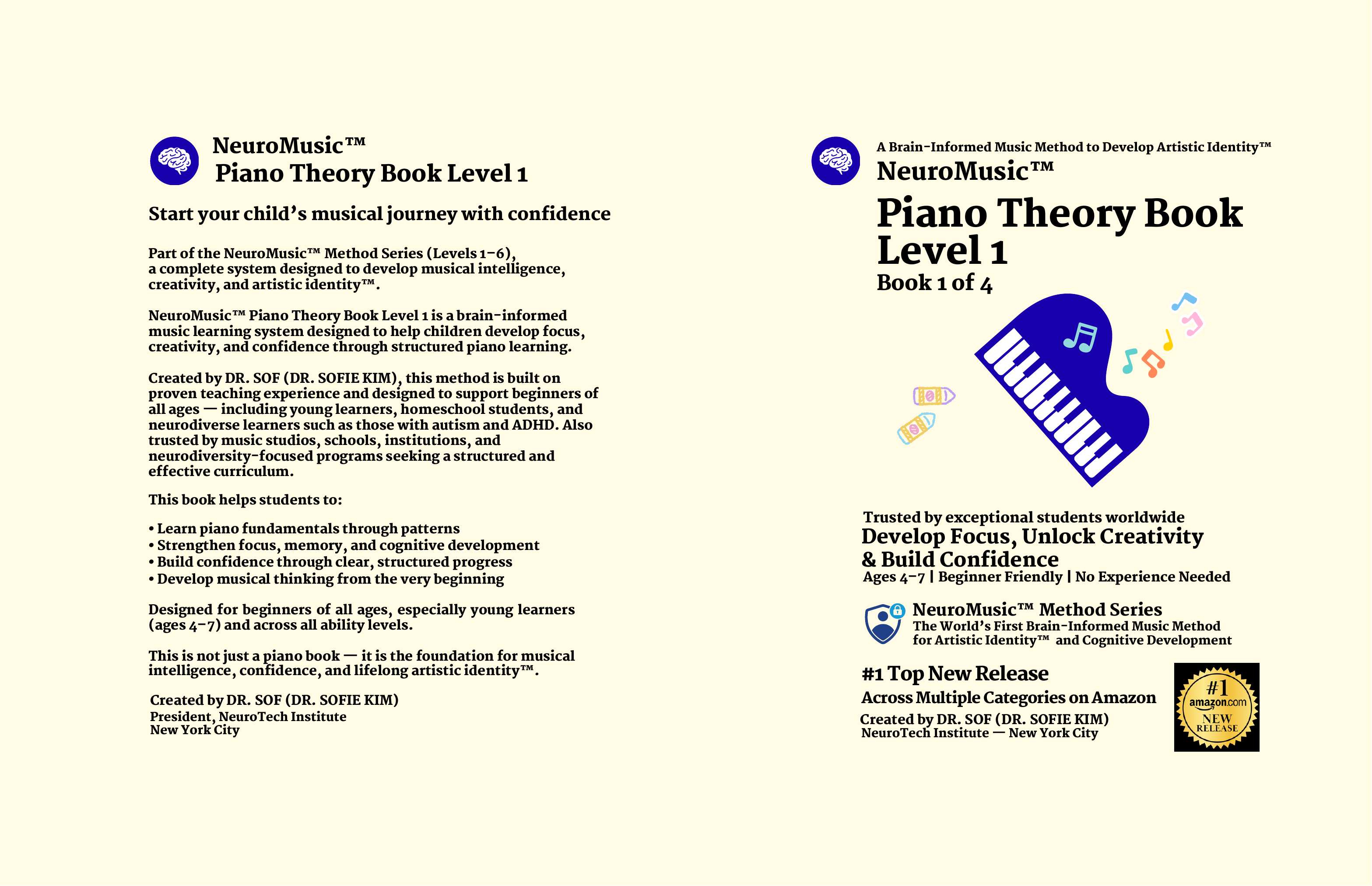
Begin with Level 1
Clear visual structure, pattern based learning, and creative development make the first level welcoming for beginners and meaningful for teachers and families.
Explore the complete seriesTechnical skills are only the beginning. NeuroMusic™ invites students to create from the start, developing musical knowledge, original work, and a distinctive Artistic Identity™. As their work grows, they can learn to document and manage their creative assets and build a professional portfolio or brand. Creative judgment and original expression remain valuable in an age of AI.
NeuroMusic™ Program Framework
NeuroMusic™ is the core methodology for every pathway below. From core learning at Levels 1–6 to Advanced Performance at Levels 7–10 and Professional Performing Arts & Emerging Technology™ at Levels 11–14, the programs extend the 4P approach and Artistic Identity™ development. These are internal NeuroMusic™ progression levels; professional assessment requirements are being developed.
Core learning pathway
Build musical understanding, piano skills, creativity, and Artistic Identity™ through the four-book 4P method.
Credential pathwayIssuer-reviewed level credentials for assessed achievement at Levels 1–6.
Levels 7–10
Extend the NeuroMusic™ method into advanced interpretation, performance, and an individual artistic voice.
Credential pathwayIssuer-reviewed level credentials for assessed achievement at Levels 7–10.
Levels 11–14
Extend the NeuroMusic™ pathway from core learning at Levels 1–6 and advanced performance at Levels 7–10 into professional performing arts, creative projects, and emerging technology at Levels 11–14.
Credential pathwayIssuer-reviewed individual credentials for assessed achievement at Levels 11–14, with an overall program completion certificate after Level 14 and all approved program requirements. Each level requires distinct assessment criteria and final authorization by NeuroMusic™.
Music and media creation
Develop creative work across music, media, and AI-supported processes using the NeuroMusic™ framework. Explore emerging Super Intelligence (SI) through creative discussion, with educator guidance and human assessment.
Credential pathwayIssuer-reviewed credentials for program completion, assessed creative projects, and verified performance records. Awards are recorded separately when verified.
Artist development and recording
Extend Artistic Identity™ into original music, recording, and a documented creative portfolio through a NeuroMusic™-based project pathway. DR.AI™ centers on Artistic Identity™ while creative technology discussions explore AI and emerging Super Intelligence (SI).
Credential pathwayIssuer-reviewed program completion credential recording the year of completion, with separate credentials for assessed project achievements and verified performance records.
Through NeuroMusic™ Levels 1–6, learners follow the Perceive → Practice → Play → Perform pathway to build musical knowledge, performance skills, and creative expression.
Our development roadmap includes AI-supported practice guidance and teacher-reviewed progress tools. As technology evolves toward superintelligence (SI), human teaching, meaningful assessment, and Artistic Identity™ remain central to our approach.
NeuroMusic™ helps students develop musical skills and Artistic Identity™, build creative portfolios, and work toward assessed certification. It welcomes homeschool families, international students, and neurodivergent learners, with flexible pacing and clear learning goals.
ED-ID™ (E-ID™) connects your education records and credentials. ArtID™ connects your creative projects and performances.
Digital signatures verify issued records and their current status. Students need no cryptocurrency or wallets. Private evidence is shared by permission.
Foundation: NeuroMusic™ Method, Levels 1–6. Advanced Performance: Levels 7–10. Professional Performing Arts & Emerging Technology™: Levels 11–14. Both extensions are distinct programs based on the NeuroMusic™ foundation, with separate assessment requirements and ED-ID™ education credentials.
Phase 1 assessment standards are active. Each credential requires an assessed outcome summary, dated evidence and final issuer review. Professional completion requires all four assessed professional levels.
One continuing ArtID™ links an artist’s chosen public name, brand and verified website with two layers: assessed achievements and creative work records. AI Media Music® Creative Programs and DR.AI™ Legacy Sounds Project use this framework. Completion, assessed skills, workshop participation and awards are separate records; AI.M® Awards link to the recognized work.
Creative work verification shows the approved title, version and registered file fingerprint. Contributor, human/AI and rights declarations stay restricted for review. Files are private by default. Artists choose what to share and retain control of their websites. Public profiles exclude private registration details.
ED-ID™ and ArtID™ can be connected by permission. Identity numbers stay unchanged while profile details receive dated updates. Authorized issuers correct credentials with replacement or status records; revised creative files receive new versions and fingerprints. Private names, contact details, guardian information and files stay off-chain. Registration does not itself establish ownership or prevent copying.
NeuroMusic™ Adoption Partners adopt the method and receive scope-specific teaching authorization after training and approval. Educational & Creative Collaboration Partners collaborate on workshops, projects or credential services without adopting the method. Their own programs retain their own issuer identity.
Partner IDs connect partnership certificates with agreed scope and validity dates. Certified Implementation Partner recognition requires standards review; annual Distinguished Partner Awards require published selection criteria. Partnership alone does not confer teaching authorization or an award.
The sign-in portal supports private ED-ID™ and ArtID™ registration, dated profile updates, private creative files, submitted records and owner-reviewed digitally signed issuance. Issued records have a shareable verification link and current status. Versioned Phase 1 assessment standards are active; website control can be verified through DNS, and students can export their signed records.
Teachers review student work, and NeuroMusic™ provides final authorization. NeuroTech Institute supports education and implementation; BlockchainX develops verification technology.
Credential services are in development. Receiving institutions decide how to recognize each achievement.
Our private Phase 1 pilot demonstrates digitally signed Levels 1–14 samples, ED-ID™ fields, and QR verification. Pilot access is restricted to authorized viewers. Blockchain anchoring and real learner issuance are still in development.
Created by DR. SOF
DR. SOF (DR. SOFIE KIM), Ph.D., is a GRAMMY®-recognized Professional Artist, LATIN GRAMMY®-recognized Associate Artist, two time recipient of the Steinway & Sons Excellent Educator Award, multi category #1 Amazon author, and President and Founder of NeuroTech Institute in New York City. An internationally recognized educator, professional performing artist, researcher, and higher education curriculum expert, she is building a global learning infrastructure for brain informed creative music education.
She has guided exceptional students worldwide, including neurodivergent learners, toward academic achievement, international music awards, admission to prestigious universities, graduation with honors, and professional careers.
NeuroMusic™ extends beyond the book series through specialized teacher training, curriculum implementation, and educational partnerships. Independent teachers, private studios, schools, universities, homeschool communities, and organizations serving learners with special needs can explore training and approved implementation within their own educational setting.
NeuroMusic™
Methodology & Credential Authority · Curriculum · Teacher Training · Global Partnership Network
Founded by DR. SOF (DR. SOFIE KIM), our ecosystem connects NeuroMusic™ methodology, NeuroTech Institute education, BlockchainX credential verification, and AI.M® Awards creative opportunities.
Our vision is to help educators and artists use increasingly capable AI responsibly—supporting learning and creativity while preserving human judgment, clear achievement standards, and trusted records.
NeuroTech Institute — Education & Implementation Partner
BlockchainX — Blockchain Credential Technology & Verification Partner
NeuroMusic™ is an independent music education methodology and credential authority, building a global network for independent teachers, studios, educational organizations, and organizations serving learners with special needs. By authority of DR. SOF (DR. SOFIE KIM), NeuroMusic™ defines its method, assessment standards, teaching authorization, and final credential approval. NeuroTech Institute supports education, training, assessment, and implementation, while BlockchainX develops the credential and verification infrastructure. Credential pathways extend across NeuroMusic™ Levels 1–6, Advanced Performance Levels 7–10, and the professional and creative program pathways.
Professional development in the NeuroMusic™ method, 4P learning path, brain informed teaching, Artistic Identity™ development, and documenting evidence for credential assessment.
Structured support for integrating NeuroMusic™ as a distinctive program within a school, university, academy, studio, or cultural organization.
Long term collaboration for curriculum development, educator training, student programs, research, and global educational initiatives.
The NeuroMusic™ Community
Bring NeuroMusic™ into your existing learning community through educator training, a structured curriculum, and creative pathways. Help students build musical skills, develop Artistic Identity™, and document work they can carry forward.
Give your studio a distinctive teaching pathway with the four connected books, the 4P method, and clear level milestones. Teacher training supports consistent delivery, while portfolios help families understand progress. Explore composition, creative projects, and performance opportunities alongside lessons.
Bring structure to music learning while choosing activities and pace with a teacher or parent. Keep a portfolio of practice, original ideas, and performances. Work toward assessed achievements that explain what the learner has completed and demonstrated.
Explore visual structure, musical patterns, and creative expression for learners with different support needs. Educator training can support individual pacing and appropriate assessment accommodations. Document each learner’s progress and strengths while keeping achievement requirements clear.
Build a coherent music pathway from NeuroMusic™ Levels 1–6 through Advanced Performance Levels 7–10 and Professional Performing Arts & Emerging Technology™ Levels 11–14. Extend learning through AI Media Music® Creative Programs and DR.AI™ Legacy Sounds Project, with program-specific requirements and educator preparation.
Connect your educators around a shared teaching framework, exchange practical ideas, and explore creative collaborations. Planned educator consultations will offer a place to discuss teaching challenges and implementation. Students can apply for available global performance and creative opportunities; participation is subject to each opportunity’s requirements.
The credential portal connects approved achievements with assessment requirements and permitted evidence. Students and families can share verifiable records with other educators and institutions. Every credential requires final authorization by NeuroMusic™; receiving institutions decide how to recognize it.
Blockchain Credential Verification
Partner schools and studios can connect NeuroMusic™ teaching with a structured record of what students have learned, created, and performed. The credential portal brings assessment requirements, approved evidence, and issuer details together in a portable record.
Homeschool educators and international partners can use the same framework to document musical learning. Teacher training will address individual pacing and appropriate assessment accommodations for neurodivergent learners, while keeping achievement requirements clear and requiring final authorization by NeuroMusic™.
Show the level or program completed, the skills assessed, and the approved creative or performance evidence behind each achievement.
Train educators to use defined NeuroMusic™ requirements and prepare recommendations for review. Every credential requires final authorization by NeuroMusic™.
Students can export earned credentials and share permitted portfolio evidence with another teacher, school, or program. Receiving institutions decide how to recognize the achievement.
The public verifier checks the issuer signature and current credential status. Approved educator and studio credentials will state the authorization granted and its validity period; membership alone does not grant verified status.
Students or parents submit work. Teachers review and recommend. NeuroMusic™ reviews the recommendation and provides final authorization. After approval, the live system will issue a signed credential and its blockchain proof, with a verification link or QR code. Teachers and families will use the website without needing cryptocurrency or a wallet.
Student information and recordings are planned to remain in protected storage, with evidence shared by permission. Blockchain will hold a cryptographic proof, not the student’s personal record.
Development status: The sign-in portal supports registration, evidence submissions and owner-reviewed digital issuance. Assessment requirements must be approved before education or achievement credentials are issued. Bitcoin timestamp proofs require verified confirmation. Blockchain verification checks authenticity; it does not confer accreditation or guarantee admission.
Connect with NeuroTech Institute to explore teacher training, institutional implementation, or a NeuroMusic™ partnership.